Architecture in an Urban Context

Study Programme 
The general syllabus of the Master’s programme applies to both the first and second year of the programme. The overriding study-methodological framework is closely tied to the three concepts of individual programming, fieldwork and scale-sliding. The progression from first till second year is achieved by developing the individual student’s personal skills and methods through research and project based practise with the purpose of qualifying the programmatic ideas of the projects and their formal and structural expression. In study department 2, the progression manifests itself through practise administered by a joint timetable with different elements programmed for each year. The department is organised in units that usually consist of at least two professors and up to twenty students. The group of up to ten foreign and ten Danish students forms one of these units.

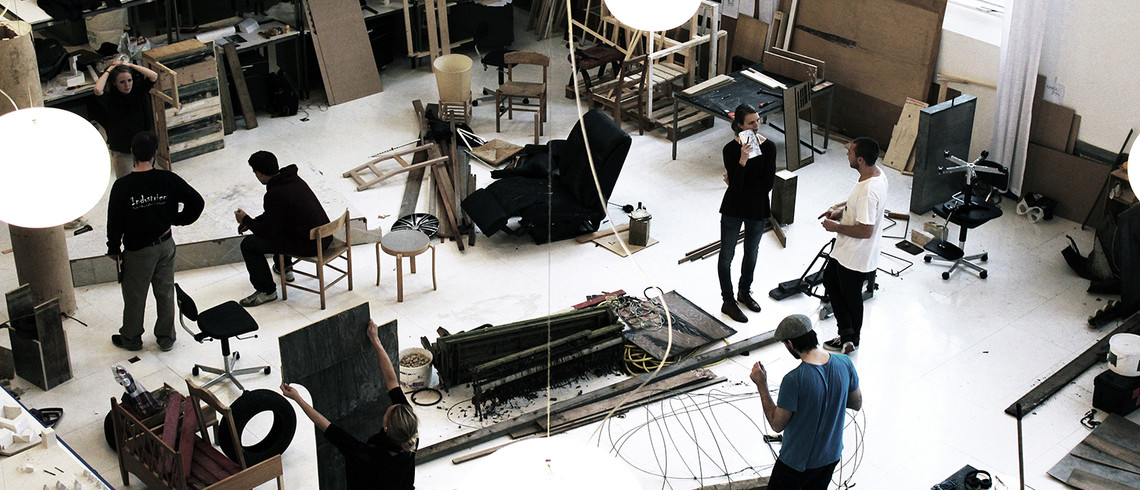
First year’s syllabus focuses on experimentation where making is essential. Experiments may involve designs, which are developed based on individual thematic or programmatic interests.

During the second year, thinking and reflection take a higher priority as research oriented knowledge serves as a basis for the students’ diploma programmes and projects.

Field studies as research and design method
Each year in October,both bachelor and master’s students in  the department travels to a carefully chosen city abroad. Participation is obligatory. To perform studies within a certain period of time, in close relation to a specific city is the first and foremost purpose of fieldwork. An intense dedication arises from a feeling of being “at home” both professionally and domestically.
The studies include explorative studies focused on structures of social and cultural life in society, living conditions and behaviour. The studies include the exploration of architectural ideas by investigating existing sp aces and buildings, and identifying characteristics, similarities and inequalities in the complex urban network.
The purpose is to uncover the city’s secrets through one’s presence at selected sites for an extended amount of time, to perform accurate registrations and measurements of ”sites” as a basis for project work and to apply the discoveries made during the field work to prepare assigned and individual programmes, which clarify each student’s personal stance and point of departure

Methods of working
Another central concept in the department’s work is ‘scale-sliding’ according to which architectural conditions and proposals are studied by developing projects on various scales in simultane­ous projects. Working between scales related to the body and scales related to the city is a fundamental part of the department’s aim to create architecture within an urban context. Another important concept is learning by making: models and drawings are basic working media mixed with individually chosen or invented media.

Content of master’s programme - first semester
The semester consists of four basic elements:

- Exercises assignments and lectures prior to the study tour
- Fieldwork
- Project / Proposal
- Final presentation of results and preparation of individual programmes based on the elements of the semester    

First element: Exercise prior to study tour
The objective is to engage in an imagined place through a few accessible data. To study the city in the gap between actual data and imagination prior to visiting the actual place. The objective is to learn from what already exists, to inherit tradition – transgressing with a critical attitude to work ones way into the built in a concrete fast and direct way, to strengthen the ability to apply an analytical approach – and to put the achieved results into use in a proposal of one’s own. From the outset on, the analysis – through the use of tools, media and techniques of the architect – will advance towards a thorough in-depth understanding of the architecture at hand.

During the first semester, the programme for the year is designed by the department, and the elements of the programme serve to develop the students’ individual architectural position.

Second element: Fieldwork 
The objective is to find a place/site to which the individual projects, developed during the semester and the whole year of study, will be attached/related. To create a focal point and specific interest in relation to the individually chosen site. To gather information, knowledge and registrations as a basis for further project work and later individual programming.

Third element: Project / Proposal

The objective is to draw up a concrete architectural and functional proposal. Based on findings of ideas and context during the fieldwork.

Fourth element: Final presentation of the results and discoveries during the autumn semester 
The objective is to create an individual focal point based on elements one thru three, preparing the individual programme for the second semester.

Master’s programme - second semester
Within the common framework laid out by the department, students will be asked to programme a semester assignment.

The department organises a phase-division of the assignment, sets forth the requirements during the phases and schedules the presentations, which seek to structure the outcome of the process.

During the course of the project, the framework will integrate periods of courses, workshops and other activities. The students choose courses in order to acquire knowledge and skills, and gain insight into theory, analysis, methods, programming, technology and practise.

In order to intensify this process, a number of concepts, tools and methods are introduced to train and improve the students’ ability to understand and produce programmes, and use the programmatic content in interplay with the architectural statement / proposal.

During the spring semester, usage of the individual programme as part of a proposal is practised through methodical development of drawings, models and written statements. Each student’s portfolio work presents their reflections and development through the different yet interrelated assignments in the course.

It is a necessary prerequisite to be able to understand, develop, and use the programmatic content in interplay with the architectural statement.

Master’s programme - third semester
During the third semester, the timetable is repeated from the first semester. Fieldwork serves as an important joint activity for students of both years. The students each choose a site in the field, and describe their goals and ideas of specialisation. It is assumed that each student can express the content of the elements during the course of study, and has built the necessary academic grounding.  The semester wraps up with a project, which consistently documents the ability to create a proposal incorporating the programmatic content and theme, as well as the chosen methods and media. The second year focuses on reflection and in-depth study.

Master’s programme - fourth semester
During the second year, a programme for the student’s thesis / diploma project based on the discoveries, knowledge and interests obtained during their previous work is created.

The thesis is an individually selected and programmed assignment.

The department requires programmes that use as their point of departure experiment and absorption rather than assignments of retrospective reflections on already acquired, profession-related positions. The diploma project period is a part of the study and the department supports projects, which seek new architectural ideas and solutions. 


Browse student projects from study department 2 in an extract from KA12, the school yearbook.