FAQ - the educational programme and admission
Here are a number of frequently asked questions directed to the international office regarding the architecture programme.
Who may apply for the English-language Master’s programme at the Royal Danish Academy of Fine Arts School of Architecture? Foreign students are eligible for admission if their qualifications are assessed as being comparable to the Danish entrance qualifications for the Master’s level. Students with a Bachelor’s degree (or the equivalent) from a state-recognised Danish or foreign school of architecture may apply for admission. This means that students from schools of architecture without the Bachelor-Master’s system are eligible for admission if they have completed three years of architectural studies.
Do you already have a Master’s degree in architecture or post-graduate diploma qualification?
We are not admitting graduated architects due to a limited number of student places. We are giving priority to applicants with a Bachelor degree or students who have completed three years of architectural studies.
What are the language requirements for applicants to the English-language Master’s programme?
Language tests are not required for Scandinavian students if they have English on B-level or the equivalent from qualifying exam (documentation required).
Non-Scandinavian students must verify their language proficiency. Minimum requirements: TOEFL paper based - 550, TOEFL internet based - 80, IELTS - 6.0. Cambridge Exams – C1
Students who have earned their full Bachelor degree in English are also exempted (documentation required).
Which educational programmes are offered at the Royal Danish Academy of Fine Arts School of Architecture?
The School of Architecture only offers one programme, namely the architecture programme, which is divided into a Bachelor programme and a Master’s programme.
Presently, the school consists of nine departments all of which teach the subject of architecture. These departments are named as follows:
1) Architecture, city and landscape
2) Architecture, city and building
3) Architecture, process and project development
5) Architecture, space, development and building culture
6) Architecture, space and form
7) Architecture, space and production
8) Architecture, experiment and technology
10) Architecture, conditions and vision
11) Architecture, design and industrial form
Which specialty subjects are offered and how do the different departments differ?
The programme is laid out in a way, which allows each department to cover the programme in its full width on a Bachelor level. In addition, each department has its own specific focus, which constitutes the specialty of each department for students on the Master’s programme. Each department has its own area of responsibility, so to speak, within the main fields of architecture, covering subjects such as design, architecture and planning, and all departments use “architecture” as their approach to the study programme.
During the course of study, each department’s special focus and area of responsibility will increasingly come into focus. All Master’s students will become architects, but the Master’s programme specifically targets each department’s individual area of responsibility.
Can I study to become an interior designer at the Royal Danish Academy of Fine Arts School of Architecture?
No, the Royal Danish Academy of Fine Arts School of Architecture does not offer an interior design programme. However, during the course of your studies to become an architect you will be exposed to interior design as an integral part of the creation of architecture. If you are specifically interested in interior design, however, we recommend that you consider another study programme.
How long is the study programme?
The standard time limit of the study programme is 5 years, and the programme consists of a 3-year Bachelor programme and a 2-year Master’s programme. The average student’s time of study, however, is close to 6 years.
Is it possible to study remotely, in the evenings or on the weekends?
No, classes are only offered in the daytime. A normal work day begins at 9:00 hrs. and ends at 17:00 hrs.
How many hours per week should I expect to spend at the school?
Especially, in the beginning of your study programme, you should expect to spend a full work week at the school, corresponding to 40 hours a week. While working to meet project deadlines, however, many students end up spending way more than 40 hours at the school.
What is the calendar for the school year?
Autumn semester: 1 September – 31 January
Spring semester: 1 February – 30 June
Graduation and final presentation take place in January and June. No official holidays during the study year except for the Christmas Holiday (at least 24 December – 31 December).
Will I be able to work while I study?
Normally, students are advised not to work during the day while studying. It is our impression that especially in the beginning of an educational programme, demands on students are great and thus working while studying is not recommended.
Is an internship included in the programme?
An internship may replace certain elements of the Master’s programme.
Does the school offer dormitory accommodation or student housing?
The school offers assistance to exchange students and international full-degree students looking for housing, but does not offer dormitory accommodation.
How high is the unemployment rate for graduates?
The construction industry and hence the profession of architecture is very cyclical. In other words, unemployment is high and unfortunately on the rise. Among recent graduates, approximately 2/3 can expect to be unemployed for a shorter or longer period of time. However, a number of initiatives that aim to combat this problem have been launched.
How are classes taught?
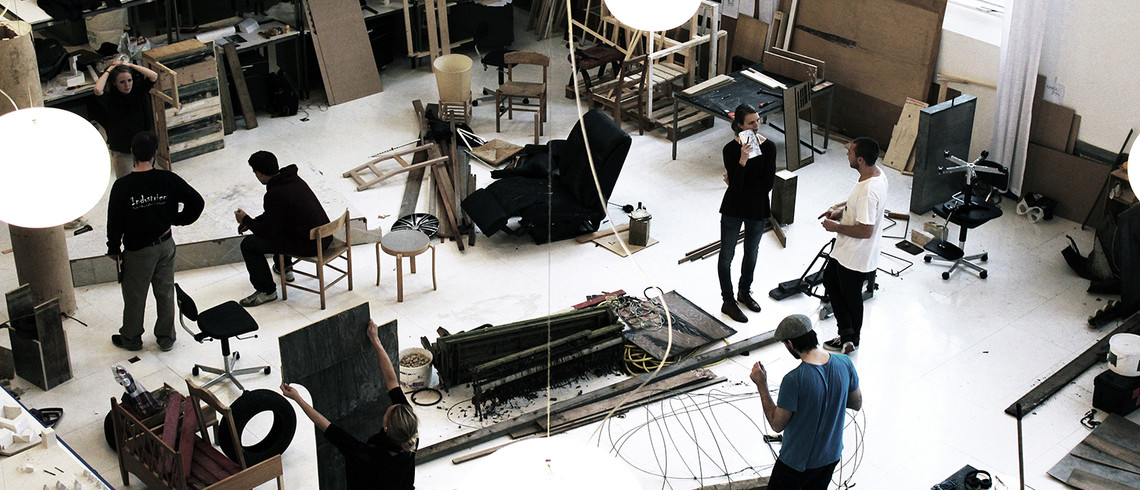
In-class instruction is usually taught in the drawing halls by the drawing tables in a close dialogue with teachers and co-students. In addition, in-class instruction is supplemented by special courses, lectures, seminars and study tours.
How and when do you choose a department?
You choose a department before applying to the School of Architecture. Departments 2, 3 and 11 accept international, full-degree students whereas departments 1, 3, 7, 8, 10 and 11 accept exchange students.
Can I study abroad during my studies?
The School of Architecture has signed exchange agreements with other schools of architecture all over the world, allowing graduate students to complete part of their Master’s programme at a school abroad. Students may apply for an exchange programme – for 1 or 2 semesters – which is seen as an important and educational supplement to their studies at KA.
What is the tuition fee?
The programme is free of charge for applicants residing in countries within the EU/EEA. For non-EU/EAA citizens tuition fee is 5.000 EURO per semester.
Additional study-related costs such as learning materials, books, travels etc. amount to approximately DKK 10,000.00 per year. Students are also required to acquire a computer.
Applicants from countries outside of the EU/EEA are required to pay tuition if they wish to partake in the study programme as regular or credit-awarding students.
Does the School of Architecture offer scholarships for international students?
The School of Architecture does not offer any scholarships for international students. Our expirience is that foreign students search for financial support in their home countries.